

Every time I work with a customer in regards to System Center Service Manager (SCSM) the conversation eventually turns to SLO’s. Regardless of the customer I always find myself spending a lot of time explaining what the best use of SLO’s are and how to use them well within their organisation, so I thought I’d put together this blog to explain them, and then, more importantly, why you should kill them with fire! (In most circumstances)
Service Level Objects are a core piece of the ITIL standards and are well and truly built in to the Microsoft System Center Service Manager (SCSM) product (as well as most other ITSM products).
In simple terms, SLO’s are a measure of time that an organisation attempts to meet to ensure service is delivered on time and to reduce customer downtime.
Organisations either have hard and fast SLO’s that have contractually agreed to with their customers, or at least have some idea of what time-frames they want to deliver services to their customers.
An example might be, For Priority 1 Incidents, someone from the IT department aims to respond to the customer within 1 hour and have the Incident resolved within 4 hours.
Another might be for service requests, for example new user accounts, will be received and completed within 2 working days.
Having SLO’s such as these allow Service Desk managers to ensure that services are delivered on time and service desk staff are responding to these calls within time.
Service desk managers can then have a nice stop light style report to placate upper management that the IT team is doing what they are supposed to be doing.
For most organisations this is all that SLO’s provide.
However, some organisations have contractual SLO’s that they MUST comply with under penalty of a fine or some kind of repercussion. These are rare when the ITSM organisations are internal departments of a larger organisation however in organisations that have some or all of their ITSM outsources to a manage service provider, contractual SLO’s are key. These organisations require this metric to limit cost and damage in the agreed to contract.
However, most of us do not have these fixed contracts and the SLO’s that we use are defined and created based on our “Gut Feel”.
Customers ask me what the best practices are and ask for my advice on what SLO’s they should setup.
The one question I always ask is “What will you do if an SLO is Breeched?”
What are you as an organisation going to do if a Priority 3 Incident that has a fix time of 2 weeks breeches?
Most customers say “Nothing. It’s just a metric to show how successful we are being.”
My response to that is “Why alert on something that we are going to do nothing about?”
We should not be wasting time reporting on things that do not affect a business decision in an evidence based way.
More importantly, does hitting 100% of your SLO’s mean you are doing a good job?
Are customers happy?
SLO’s don’t tell us that, they just tell us we resolved it within a given window. I heard this called “Watermelon SLA’S” at the recent ITx NZ 2018 conference. 
Watermelon SLA’s are green on the outside and red on the inside because the SLA is met but the customer is unhappy.
This is where we get to the crux of this article.
If we do a terrible job quickly is it better than doing a good job slowly?
If we hit all of our SLO targets but our customers hate the service we are delivering then have we really succeeded?
A much better approach, in my opinion, is Net Promoter Scores.
While attending the Australian itSMF conference this in 2017, I was able to hear Dave O’Brian (of www.SilverSix.com.au) talk about the use of Net Promoter Scores (NPS) in replacement of SLO’s.
This rang so true that I decided to write this blog article about it.
Net Promoter Score (NPS) is a way to gauge the level of satisfaction of a service companies customers. It is a survey ask of customers that consists of a single question: How likely is it that you would recommend our company/product/service to a friend or colleague?
The scoring for this answer is most often based on a 0 to 10 scale
Does this sound familiar?
Ever had that question from a follow-up questionnaire or survey from your telco or ISP?
Maybe your Gas or electricity company?
I even got asked to fill in an answer to this question today in the airport when ordering my Pad Thai noodles.
Ever use AirBNB?
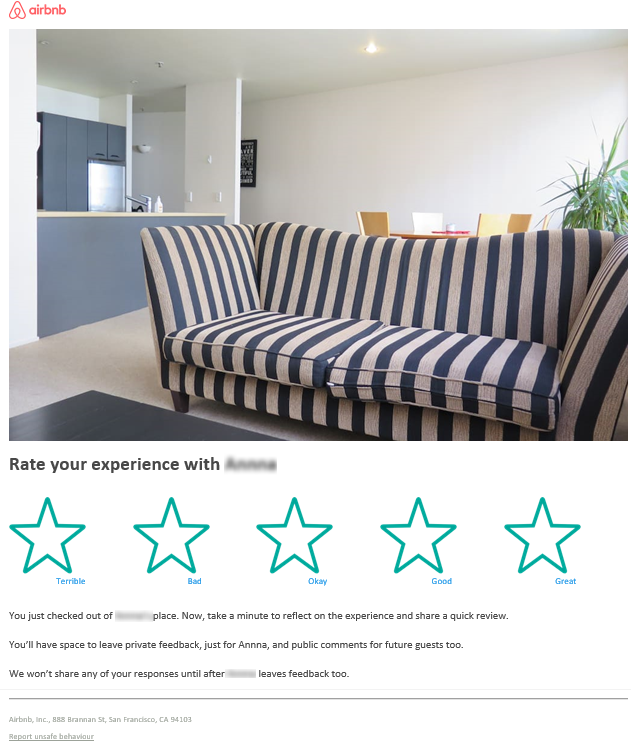
NPS is everywhere even if you didn’t know what it was called.
Before we get in to why NPS is better than SLO’s, how is an NPS calculated?
In essence it is a single question to get direct feedback from your customers on how satisfied they were from the interaction that they just had with you, the service provider.
If the customer gives you a score of 9 or 10 they are categorised as a Promoter of your service. These people are the ones that send the service desk that nice e-mail to say thanks for the effort and how awesome so-and-so was in getting them back up and running quickly and without fuss. We all have had a “Brag Board” from time to time with such e-mails. These are the customers we don’t worry about.
If the customer gives you a score of 7 or 8 they are categorised as a Passive consumer of your service. They got what they expected. No worries there. This is where most of us sit and where most of our customers will sit too. These people called\E-Mail looking for a solution and they got it. They moved on and got their work done. Nice. These are the customers we don’t worry about.
If the customer gives you a score of 6 or lower they are categorised as a Detractor of your service. We have all met some-one in this category and I feel very confident in saying we have ALL been in this category from time to time. Do you know the experience of getting terrible customer service from your Phone\ISP\Electricity\Gas provider where you are on the phone for endless hours listening to the same looped hold music tell us that our “Call is important to us” pffft. Yeah right.
When we get this level of service do we just accept it and move on, or do we tell our friends and co-workers all about how bad the service was for X company or how many hours we spent on hold, or how useless Blah was in solving anything?
These are the detractors that damage our “Brand”.
These ARE the customers we want to worry about.
So how does this NPS thing work?
Well first off, it’s direct feedback from our customers, not some arbitrary time that we have assigned to x priority classification of issue. Therefore it is targeted and not just a random “Finger in the air” on how we are actually doing.
When a user provides a score back to the service desk, we collect this and calculate a score by subtracting the percentage of customers who are classified as Detractors from the percentage of customers who are classified as Promoters.
Anyone classified as a Passive respondent counts toward the total number of respondents this decreases the percentage of Detractors and Promoters and trends the score toward 0.
An NPS that is positive (i.e., higher than zero) is felt to be good, and an NPS of +50 is excellent.
Why is this score better than SLO’s?
SLO’s are good at telling us how long we take to do a thing, but not if we do it well or not.
What’s the point in hitting 99% of our SLO of fixing all P2 Desktop issues in 1 hour or less if our customers hate us and the issue is never really solved?
Ask yourself, as a customer, would you prefer to get an answer from the Telephone company in less than 5 minutes on the phone but then have to call again a few days later to chase it up or to fix another issue that was caused because of a rushed effort in the first place?
Or would you prefer to call once, spend a reasonable time on the call and get it fixed once and for all without needing to chase and chase?
This is the heart of replacing SLO’s with NPS.
There are other benefits too…..
Using an NPS approach to gaging service success has other benefits other than just being able to track the true state of our service.
The fact that the score and feedback on a response in specific and targeted we can use this data in a live and interactive method to head off issues before they get out of control.
As an example, a customer calls to get their password reset and the service desk staff reset their AD password for them. Nice simple call right? Job answered, logged and fixed well within the SLO and we are green across the board.
However, the customer responds with an NPS of 2.
As a service desk manager or even an appointed Customer Care Representative for the day or week, you can call that customer immediately and ask them directly, “Why did you give us a score of 2?” “Is there something else that is causing an issue that we can fix for you to get your systems back and operational again?”
This allows us to address any issues with speed and accuracy and provide a better service to our customers.
- The particular customer may have had an issue with the way the service technician spoke to them.
- They may have had an issue with only the one AD password being reset and not their 3 other business apps.
- They may have a totally unrelated issue that they somehow believe is related.
Either way getting this feedback immediately allows us to address this for them and to either improve our processes or to resolve their issues for them and get them back to work, which, after all, is what we are here for.
OK, so how do I go about it?
Only you know how to best communicate with your customers.
Some of them might be great at replying to an e-mailed survey in their inbox (not likely in my experience)
Some might like the direct question asked to them via the phone as they are about to hang up. (I don’t find this a reliable way of receiving honest feedback, but it is even more direct and faster to respond to)
A simple start rating at the bottom of a “Thanks for your call. Here’s your reference number” e-mail is simple and easy for people to respond to quickly.
In short, what is the path of least resistance for your customers that gives you the information you need?
Ever seen those smiley faced buttons in airport toilets asking how clean and tidy you thought things were?
Ever asked to review an item you purchased on eBay?
Ever taken an Uber?
All of these are examples of NPS.
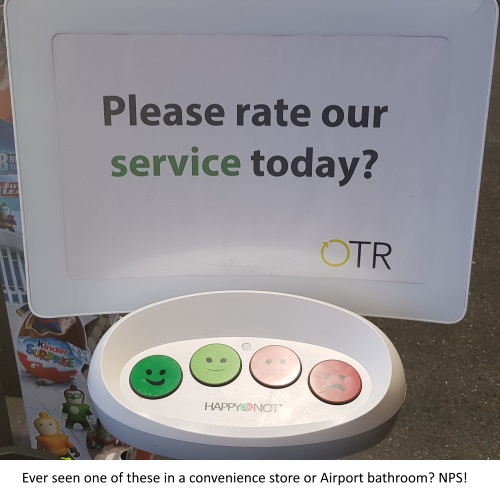
But wait? Some of those are 5 stars? Didn’t you say I had to use 10?
Well yes I did, but the principle is the same, just move the target.
- 5 are Promoters.
- 4 are Passives.
- 1-3 are Detractors.
NPS has been widely adopted across all manner of industries , across any area that deals with service management of customers. More than two thirds of Fortune 1000 companies using the metric.[2]
So take a long hard look at what you are trying to achieve with your reporting and metrics and what defines success for your organisation and consider using NPS instead of SLA’s give you the metrics you need to succeed.